
Circulaya
We are the project consortium behind BioReCer, an EU-funded Horizon Europe innovation action led by CETAQUA and coordinated with support from nova-Institut GmbH. In our final multi‑stakeholder meeting we presented the project’s key achievements: a comprehensive sustainability and circularity framework for biological feedstocks, a practical guideline to integrate that framework into existing certification schemes, a socio‑economic analysis on certification uptake, and a working, mobile‑first ICT application — the BioReCer IC Tool (the „BIT“) — that supports traceability, self‑assessment and digital product passports. This article summarizes our results, the evidence that emerged from stakeholder dialogues and experiments, and the feedback we received from certification bodies, industry and consumer representatives.
Why BioReCer: the problem we set out to solve
Europe has large quantities of biomass and secondary raw materials that remain under‑utilized. These biological resources — sewage sludge, agro‑waste, fruit residues, forest sub‑products and industrial organic by‑products — can be valuable inputs for circular bioeconomy value chains. Yet the full potential is blocked by fragmented information, limited traceability and insufficient, non‑harmonized assessment methods and indicators. The consequence: buyers, certifiers and consumers struggle to distinguish credible bio‑based products from greenwashing claims. BioReCer was created to address exactly that gap: to strengthen certification schemes, to provide measurable indicators for sustainability and circularity, and to develop digital tools that make traceability and trust practicable.
Project scope and demonstration sites
Over three years the consortium — composed of research centres, universities, private companies, certification bodies and communicators across seven countries — tested the framework and tools in four demonstrative regions. Each case study covers distinct feedstocks and regional value chains:
- Galicia, Spain: sewage sludge and canning industry waste;
- Lombardia, Italy: the organic fraction of municipal solid waste (OFMSW), sewage sludge, agro‑waste and non‑hazardous liquid organic streams;
- Central Macedonia, Greece: fruit processing residues, cereal by‑products and pruning waste;
- Sweden: forest industry sub‑products and derivatives.
These pilots validated the framework across diverse contexts and supported the development of datasets and indicators that are relevant and operational for different sectors.
The BioReCer assessment framework: what it covers
The BioReCer framework is a multi‑dimensional assessment and traceability model designed for biological feedstocks. It combines three pillars — environmental, socio‑economic and circularity — and translates them into a structured set of principles, criteria and requirements. In total the framework contains 52 requirements categorized into basic (mandatory minimums) and advanced (performance‑raising actions) levels.
The framework is not a stand‑alone label. It is deliberately designed to be integrated with existing certification schemes so they can assess biological feedstocks consistently, with quantitative circularity indicators (mass balances, reuse rates, life‑cycle relevant metrics) as well as governance and organizational criteria.
„Stakeholders — consumers, industry and experts — converged on one clear priority: companies should measure their carbon emissions and have a reduction plan in place.“ — key finding from our socio‑economic study
Key outputs: mapping, indicators and public resources
Deliverables from the project include a pan‑European mapping of biomass flows (what residues exist and where they move), a validated set of circularity indicators, and the integration guidance material for certification schemes. All public deliverables, datasets and the standards mapping are available on Zenodo and on the project website for download and re‑use.
Socio‑economic research that guided our approach
To understand whether changes in certification requirements would be effective and acceptable, Unitelma Sapienza led a multi‑method socio‑economic study:
- Delphi survey (industry & consumers, multi‑round): participants ranked a short list of seven candidate requirements to see where consensus lies. The strongest, convergent priority was the requirement for companies to measure carbon emissions and have an emission‑reduction plan.
- Analytic Hierarchy Process (AHP) with experts: experts validated the Delphi results using pairwise comparisons across criteria like reputation, competitive advantage and responsible innovation. The AHP confirmed the salience of the carbon‑measurement requirement.
- Online consumer experiment (n=400): a 3×3×2 design tested three product types (shampoo, fertilizer and face cream), three product versions (conventional, bioproduct, certified bioproduct) and two certification treatments (ISCC Plus vs RSB). Results showed: bioproducts generated higher willingness‑to‑pay (WTP) than conventional goods; adding a certification further increased WTP and purchase intention; certified products lowered perceived environmental and health risks. No consistent difference was detected between ISCC Plus and RSB in this experiment — the presence of credible certification mattered more than the specific scheme in the consumer sample.
These findings guided the priority features in the BIT and informed the emphasis on carbon disclosure, traceability and consumer‑facing indicators.
Integrating the framework into existing schemes: practical guidance
Meo Carbon Solutions led the benchmarking of more than 10 existing certification schemes (including ISCC, RSB, FSC and MSC) against the BioReCer requirements. The result is a practical guidance document composed of three components aimed at different users:
- Integration guideline — step‑by‑step advice for a certification scheme to benchmark its current standard against the BioReCer requirements and choose an integration strategy;
- Verification guidance — detailed descriptions of each requirement, the associated circularity indicators, calculation approaches and suggested evidence for auditors to look for;
- Audit checklist — an auditor‑ready tool to record findings and verify conformance to basic and advanced requirements during field audits.
Schemes can select one of two integration approaches: add‑on (use BioReCer as a supplementary module) or add‑in (incorporate BioReCer requirements into core standards). Integration requires updating standards, reporting templates and audit procedures, and training auditors and certifying bodies. Pilot assessments with ISCC Plus and real companies in wastewater and agricultural sectors informed the guidance and confirmed feasibility for many requirements.
The BioReCer IC Tool (BIT): live, mobile‑first, and practical
EGM developed the BIT as a secure, mobile‑first web application designed for three main audiences — producers and companies, certification bodies, and curious citizens/consumers. The platform is underpinned by a modern data infrastructure (NGSI‑LD context broker) for real‑time updates, but the front‑end is deliberately simple and task‑oriented.
The BIT contains three flagship modules:
- BitAdvisor (self‑assessment) — a guided questionnaire based on the BioReCer basic and advanced requirements. Companies answer yes/no/not‑applicable prompts and receive scores for environmental, social and economic pillars, plus sector averages for benchmarking. Recommendations and required evidence are displayed per answered item.
- Product explorer & digital product passport — interactive supply‑chain trees and timelines let users trace a product batch from origin to end‑use. Each product passport can contain QR codes, calculated circularity indicators (mass balance, transport CO2 estimates), certificates, and status updates.
- Certifications & standards module — searchable database of certification schemes and standards, plus a directory of companies that have self‑assessed and indicated they are open to audit. This facilitates connections between certification bodies and companies.
Additional technical features: the BIT supports automated updates via APIs, IoT sensor feeds or periodic Excel imports; default privacy settings keep data private until a user chooses to publish; an administrative interface allows creation of use cases and archetypes; and QR codes and mass balance visualisations enable practical, on‑the‑ground traceability. Current limitation: document upload (for supporting evidence and certificates) is not yet implemented and was raised as a priority for the next development phase.
What we heard in the expert roundtable: strengths, barriers and next steps
Our roundtable gathered voices from certification bodies (Din Certco), industry (Braskem), environmental agencies (Environment Agency Austria), consumer organizations (EEKE), and standard‑support bodies (ISEAL). Key points:
- Strengths
- Centralised access to certification info and chain of custody — experts valued one searchable place for certification and traceability;
- Pre‑assessment support for companies — the BitAdvisor helps firms self‑screen readiness before costly audits;
- Digital product passport readiness — regulators are moving in this direction and the BIT aligns with emerging EU policy on product information;
- User‑friendly interface and automation — automated data sources reduce reporting burden and support scalability.
- Barriers & challenges
- Data sharing reluctance — companies may be hesitant to reveal supply chains or batch details for commercial reasons;
- Evidence and verification — experts and certifiers requested the ability to upload and verify certificates and support documents to reduce fraud or misreporting;
- LCA and methodology transparency — environmental agencies asked for a clear handbook explaining how CO2 and footprint estimates are calculated, how allocation between co‑products is handled, and system boundaries used;
- Multiplicity of schemes and scheme credibility — stakeholders recommended adding a credibility/benchmark layer so users can understand differences between schemes and which schemes are suitable for particular feedstocks;
- Digital accessibility and consumer comprehension — consumer representatives urged simplified labels/ratings and awareness campaigns to avoid adding confusion to a crowded label landscape.
Recommendations coming out of the meeting
To maximise adoption and impact, we propose the following priorities for the next phase (and for scheme owners, certifiers and policy makers):
- Enable document upload and audit linkage — allow certificates, audit reports and supporting evidence to be attached and verified by certifiers in the BIT.
- Publish a transparent methodology handbook — clearly document LCA assumptions, allocation rules, emission factors and calculation steps used for the indicators so users (including policy makers) can interpret values correctly.
- Add a scheme‑credibility layer — integrate existing benchmarking frameworks (e.g. ISEAL‑informed criteria) so users can compare the trustworthiness and scope of different certification schemes.
- Offer technical support and training — provide onboarding for SMEs and certification bodies, plus a helpdesk to ease early adoption.
- Promote interoperability — continue building API‑first connectors so the BIT can exchange data with other registries, supply‑chain platforms and forthcoming EU digital product passport systems.
- Engage in outreach & policy alignment — collaborate with national agencies, Nova Institute networks and EU projects to align timelines and avoid overburdening SMEs as new EU regulations roll out.
Where to find resources and how you can get involved
All public reports, datasets and the standards mapping are available on our project pages and the BioReCer Zenodo repository. If you work in a bio‑based value chain, consider:
- Trying the BioReCer IC Tool: register your organisation, complete the BitAdvisor self‑assessment and create a use case to experiment with a product passport;
- Joining pilot audits: certification bodies can collaborate on trials that test document upload, audit checklists and the verification guidance;
- Attending our final event (Santiago de Compostela, October): a focused on‑site workshop to discuss Trust, Traceability and Certification and to exhibit project outcomes; industry stakeholders from our case studies are especially invited;
- Sharing feedback: the tool is a work in progress — your practical feedback will shape next iterations.
Concluding thoughts
BioReCer demonstrates that pragmatic, evidence‑based improvements to certification (clear requirements, measurable indicators and integrated digital tools) can materially increase trust in bio‑based products. Our socio‑economic work shows that consumers reward certified bio‑based goods through higher willingness to pay and lower perceived risk. Our integration guidance proves that certification schemes can absorb BioReCer requirements either as add‑on modules or through mainstream revision. And the BIT shows a practical path to operationalise traceability and transparency across complex value chains.
We close by inviting stakeholders — standards bodies, certifiers, companies, auditors, policymakers and consumers — to use the resources, test the tool and help shape the next generation of certification and digital traceability for a credible, circular bioeconomy.
Project resources: visit https://biorecer.eu and the BioReCer Zenodo community for deliverables, datasets and the practical guidance document.
Die Einhaltung von Vorschriften bei bedruckten Lebensmittelverpackungen stellt weltweit eine komplexe Herausforderung dar. In diesem Artikel geben wir einen umfassenden Überblick über die unterschiedlichen regulatorischen Anforderungen an Lebensmittelkontaktmaterialien (FCM) mit Schwerpunkt auf Druckfarben. Dabei beleuchten wir globale Regelungen, einen tiefen Einblick in die europäische Gesetzgebung sowie die Konzepte der Druckfarbenindustrie, um die Sicherheitslücken zu schließen und sichere Verpackungen zu gewährleisten.
Einführung in die Welt der Lebensmittelkontaktmaterialien (FCM)
Lebensmittelkontaktmaterialien sind Hightech-Produkte, die zahlreiche Anforderungen erfüllen müssen. Sie dienen nicht nur dem mechanischen Schutz der Lebensmittel, sondern auch der Information des Verbrauchers und der Sicherstellung der Funktionalität, beispielsweise durch Barriereeigenschaften.
Darüber hinaus gewinnen Nachhaltigkeitsaspekte immer mehr an Bedeutung: Zutaten müssen nachhaltigen Kriterien entsprechen, Verpackungen sollten recyclebar sein und idealerweise aus recyceltem Material bestehen. Attraktivität und Dekoration spielen ebenso eine Rolle, ohne dabei die sensorischen Eigenschaften wie Geruch und Geschmack der Lebensmittel negativ zu beeinflussen.
Globale Regulierungen im Überblick
Die gesetzlichen Vorgaben für Druckfarben auf Lebensmittelkontaktmaterialien unterscheiden sich weltweit erheblich. Zwei grundlegende Prinzipien dominieren die Gesetzgebung:
- Positive List Prinzip: Nur auf einer Positivliste aufgeführte Substanzen dürfen verwendet werden. Dies gewährleistet einen hohen Sicherheitsstandard, schränkt jedoch die Innovation ein.
- Negative List Prinzip: Alle Substanzen sind erlaubt, außer sie stehen auf einer Negativliste. Dies bietet mehr Freiheit, birgt jedoch auch höhere Risiken.
USA
Die USA regulieren Lebensmittelkontaktmaterialien über den Code of Federal Regulations, Title 21, der gute Herstellungspraxis (GMP) fordert. Spezifische Vorschriften für Druckfarben fehlen jedoch, sodass Hersteller von Druckfarben umfassende und transparente Informationen bereitstellen müssen, damit Verpackungshersteller die Sicherheit bewerten können.
Mercosur
Die Mercosur-Staaten (Argentinien, Brasilien, Paraguay, Uruguay, Venezuela) verfügen über eine Rahmenregelung aus dem Jahr 1992, die der europäischen ähnelt. Ein wichtiges Element ist die Erhöhung des Gesamtmigrationslimits auf 60 mg/kg, was eine Anpassung an europäische Standards darstellt. Für Kunststoffe existiert zudem eine Positivliste.
China
China führt mit der Norm GB48061 allgemeine Anforderungen ein, darunter die Liste A4 mit rund 200 Substanzen für Druckfarben – eine vergleichsweise geringe Anzahl. Die neue chinesische Druckfarbenverordnung (GB480614), die im September 2024 in Kraft tritt, stellt Hersteller vor Herausforderungen, da die Positivliste unzureichend für die Produktion konformer Druckfarben erscheint.
Indien
Indien verfolgt einen Negativlistenansatz, wobei Druckfarben der Norm IS 15495 entsprechen müssen. Wichtig: Direkter Lebensmittelkontakt mit bedruckten Oberflächen ist verboten, was die Anwendungen einschränkt.
Japan
Japan besitzt eine Positivliste für Polymere und Additive in Kunststoffen seit 2020, die Druckfarben jedoch nicht direkt reguliert. Stattdessen existiert eine freiwillige Negativliste der Japan Printing Ink Makers Association (JPIIMA), die etwa 700 Substanzen umfasst.
Europäische Gesetzgebung und Herausforderungen
In Europa bildet die Rahmenverordnung (EU) Nr. 1935/2004 das Grundgerüst für Lebensmittelkontaktmaterialien. Sie fordert, dass Materialien nach guten Herstellungspraxen gefertigt werden und keine Stoffe an Lebensmittel abgegeben werden dürfen, die die Gesundheit gefährden oder sensorische Eigenschaften verändern.
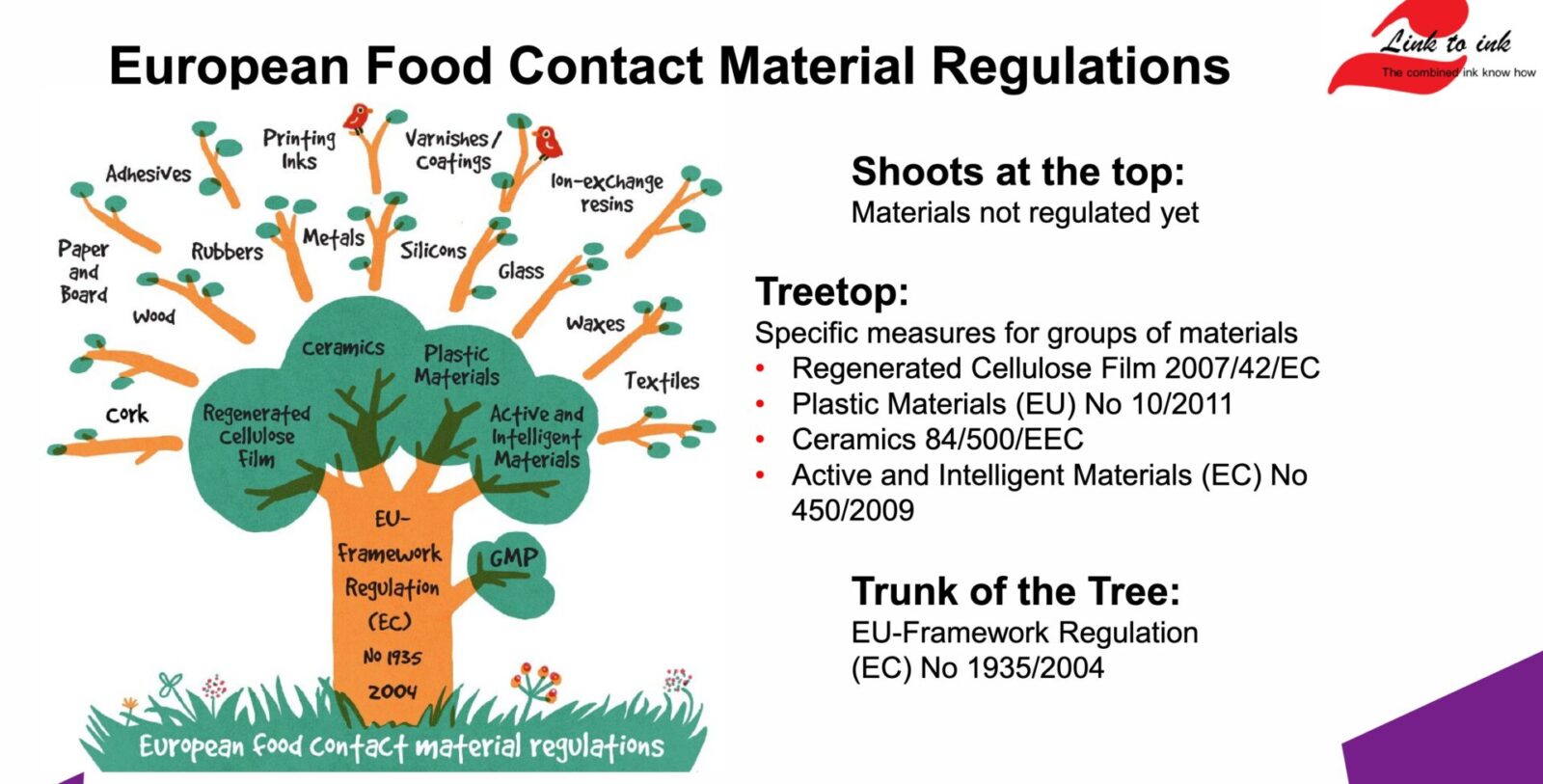
Die meisten spezifischen Vorschriften beziehen sich auf Materialien wie Kunststoffe oder Keramik, doch für Druckfarben existiert bislang keine eigene EU-Verordnung. Druckfarben müssen daher die allgemeinen Anforderungen erfüllen, wobei die europäische Kunststoffverordnung (EU) Nr. 10/2011 als Referenz für Migrationstests und Positivlisten herangezogen wird.
Good Manufacturing Practice (GMP) in Europa
Die GMP-Verordnung (EU) Nr. 2023/2006 regelt die Herstellung von Lebensmittelkontaktmaterialien, einschließlich Druckfarben für indirekten Lebensmittelkontakt. Sie legt Anforderungen an Qualitätsmanagement, Rohstoffauswahl und Dokumentation fest, um Sicherheit und Qualität zu gewährleisten.
Zukünftige Entwicklungen im Rahmen des Green Deal
Die Europäische Kommission verfolgt mit dem Green Deal und der Chemikalienstrategie für Nachhaltigkeit ambitionierte Ziele, die auch die Revision der Rahmenverordnung betreffen. Geplant ist eine stärkere Fokussierung auf den Endartikel, bei dem alle migrierbaren Stoffe bekannt sein müssen, unabhängig davon, ob sie absichtlich oder nicht absichtlich enthalten sind.
Substanzen werden nach Gefährlichkeit priorisiert:
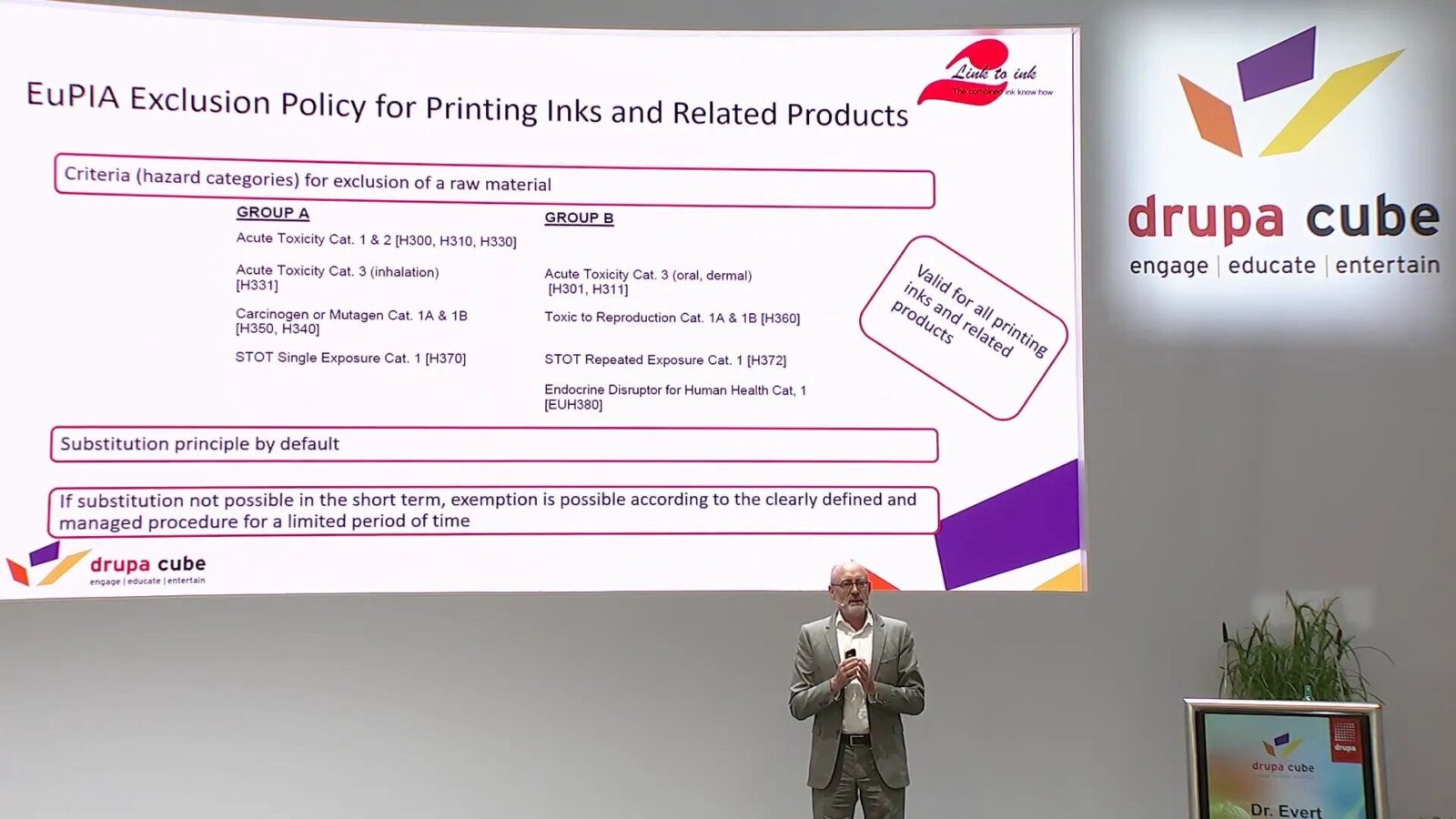
- Verbotene Stoffe, z.B. CMR-Kategorien 1 und 2
- Andere gefährliche Stoffe, die eine Zulassung benötigen
- Unbedenkliche Stoffe, für die der Hersteller verantwortlich ist
Die Förderung nachhaltiger Alternativen und die Substitution gefährlicher Stoffe stehen dabei im Vordergrund. Die Umsetzung wird voraussichtlich bis 2027/2028 erfolgen.
Schweizer und deutsche Druckfarbenverordnungen
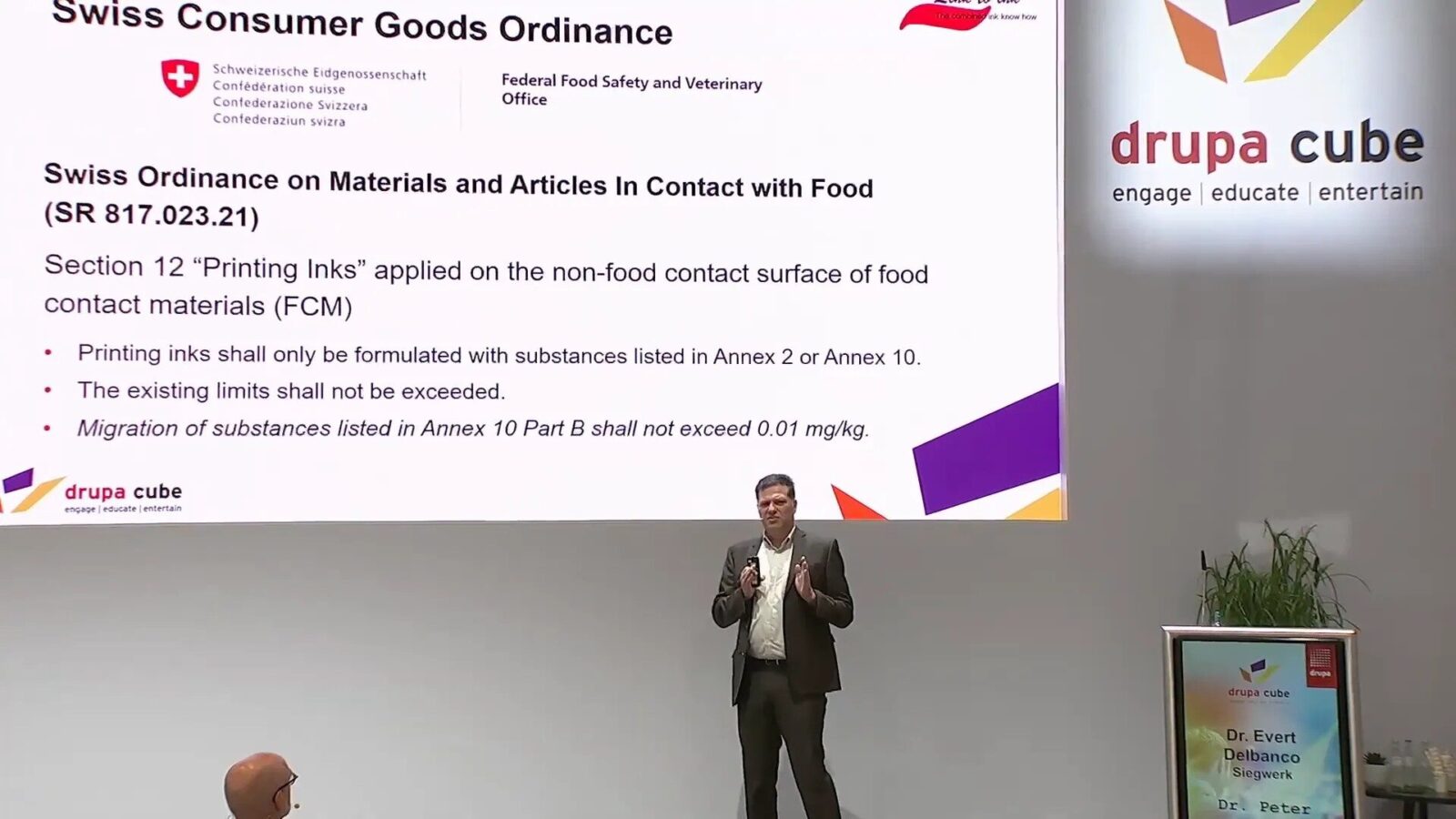
Die Schweiz ist weltweit führend mit einer eigenen Druckfarbenverordnung, die auf einer Positivliste basiert und derzeit rund 1.000 Substanzen umfasst. Eine kürzlich erfolgte Revision wird ab 2026 die bisherige Liste B abschaffen, sodass Substanzen, die unter 10 ppb migrieren und nicht CMR-klassifiziert sind, nicht mehr gelistet werden müssen.
Die Definition von CMR ( (cancerogen)krebserzeugend, (mutagen) erbgutverändernd, (reproduktionstoxisch) fortpflanzungsgefährdend) ist jedoch Gegenstand laufender Diskussionen, insbesondere im Hinblick auf Datenlücken bei der Klassifizierung.
Die Verordnung verlangt zudem eine Konformitätserklärung für Druckfarben, welche durch den „Statement of Composition“ auf Verbandsniveau erfüllt werden kann.
Die deutsche Druckfarbenverordnung
Deutschland hat als Reaktion auf die Verzögerungen auf europäischer Ebene eine eigene Druckfarbenverordnung im Rahmen der Bedarfsgegenständeverordnung eingeführt, die ab Januar 2026 in Kraft tritt. Sie regelt erstmals auch Druckfarben mit direktem Lebensmittelkontakt.
Die Verordnung setzt eine Positivliste voraus, die sich an der Schweizer Liste orientiert, aber Unterschiede, insbesondere im UV-Druckbereich, aufweist. Nicht gelistete Substanzen dürfen unter strengen Bedingungen verwendet werden, sofern sie unter der Nachweisgrenze von 10 ppb liegen und nicht CMR-klassifiziert sind.
Die Verordnung betrifft nicht nur in Deutschland hergestellte Produkte, sondern alle, die in Deutschland in Verkehr gebracht werden, und könnte sich ähnlich wie die Schweizer Verordnung zu einer de facto internationalen Referenz entwickeln.
Brancheninitiativen und Selbstverpflichtungen
Da die Regulierung von Druckfarben weltweit unvollständig und uneinheitlich ist, haben die Druckfarbenhersteller in Europa eigene Konzepte und Richtlinien entwickelt, um Sicherheit zu gewährleisten:
- EUPIA Ausschlusspolitik: Eine Selbstverpflichtung, sehr gefährliche Substanzen strikt auszuschließen und bei Neuklassifizierungen Ersatzstoffe zu entwickeln.
- Leitlinien zur Herstellung von Druckfarben für Lebensmittelverpackungen: Detaillierte Vorgaben zur Rohstoffauswahl, Herstellung und Qualitätsmanagement, die über die gesetzlichen Anforderungen hinausgehen.
- UPIA GMP: Eine erweiterte Good Manufacturing Practice, die speziell auf Druckfarben zugeschnitten ist und Kontaminationen während der Produktion minimiert.
Besonderheiten bei UV-Druckfarben
UV-Druckfarben stellen eine besondere Herausforderung dar, da sie reaktive Chemikalien wie Photoinitiatoren enthalten, die oft als Gefahrstoffe eingestuft sind. Die Industrie hat eine Liste geeigneter Photoinitiatoren für Lebensmittelkontakt entwickelt, die auch von Markeninhabern anerkannt wird.
Migrationstests und Risikoabschätzung
Migrationstests sind essenziell, um sicherzustellen, dass keine bedenklichen Stoffe in Mengen in die Lebensmittel gelangen, die Grenzwerte überschreiten. Die Industrie verwendet verschiedene Methoden:
- Worst-Case-Berechnungen, die annehmen, dass 100 % des Stoffes migrieren
- Migrationstests und Modellierungen zur realistischen Einschätzung der Migration
Darüber hinaus werden nicht absichtlich zugesetzte Stoffe (NIAS) toxikologisch bewertet, um sichere Grenzwerte (self derived SML) zu definieren. Diese Bewertungen stützen sich auf anerkannte Prinzipien der Europäischen Behörde für Lebensmittelsicherheit (EFSA).
Statement of Composition
Da es bislang keine einheitliche Regulierung für Druckfarben gibt, wird ein „Statement of Composition“ erstellt, das detaillierte Informationen über alle potenziell migrierbaren Substanzen enthält – inklusive Hauptbestandteile, Verunreinigungen und NIAS. Dieses Dokument unterstützt Verpackungshersteller und Markeninhaber bei der Einhaltung gesetzlicher und kundenspezifischer Anforderungen.
Fazit und Ausblick
Die weltweiten Regelungen für gedruckte Verpackungen im Lebensmittelkontakt sind äußerst heterogen und oft unvollständig. Während Länder wie die Schweiz und Deutschland eigene detaillierte Verordnungen erlassen haben, fehlt auf europäischer Ebene bisher eine spezifische Druckfarbenverordnung.
Die Druckfarbenindustrie reagiert darauf mit eigenen strengen Selbstverpflichtungen, Leitlinien und umfassenden Risikoabschätzungen, um die Sicherheit von Lebensmittelverpackungen zu gewährleisten. Der Blick in die Zukunft zeigt, dass mit der Umsetzung des europäischen Green Deals und der Chemikalienstrategie eine stärkere Regulierung und Priorisierung von gefährlichen Substanzen zu erwarten ist.
Die Zusammenarbeit entlang der gesamten Lieferkette – von Rohstofflieferanten über Druckfarbenhersteller bis hin zu Verpackungsherstellern und Markeninhabern – ist entscheidend, um den hohen Sicherheitsanforderungen gerecht zu werden und Innovationen zu fördern.
Derzeit sind wir in einer Übergangsphase, die viel Arbeit und Anpassungen erfordert, doch das Ziel bleibt klar: sichere, nachhaltige und konforme Lebensmittelverpackungen, die den Verbraucherschutz gewährleisten.
Published on: June 12, 2024
Discover the latest advancements in sustainable packaging through an insightful session hosted by Paul Jenkins, Managing Director of ThePackHub. This article explores key innovations in carbon reduction packaging, featuring expert insights from Dirk Endlich and Ali Siddiqui of Elopak. These industry leaders share how fiber-based packaging solutions and other innovations are driving significant environmental benefits across various sectors.
Watch the full video on ThePackHub YouTube channel: Carbon Reduction Packaging Innovations
Table of Contents
- About the Speaker
- Summary of Key Themes
- Unique Insights and New Information
- Applying the Knowledge
- Important Keywords
- Main Points Explored in the Webinar
- Frequently Asked Questions (FAQs)
- Summary and Final Thoughts
- Key Figures and Resources
About the Speaker
Paul Jenkins is the Managing Director of ThePackHub, a leading UK Packaging Innovation consultancy. With nearly a decade of experience curating packaging innovations worldwide, Paul offers an authoritative perspective on sustainable packaging trends and technologies. His expertise is complemented by insights from Dirk Endlich, Vice-President of Elopak’s P2C division, and Ali Siddiqui, Senior Key Account Manager at Elopak, who bring deep knowledge in fiber-based packaging and carbon reduction strategies.
Summary of Key Themes
- Exploration of carbon reduction innovations across packaging sectors including food, beverage, beauty, pet care, and pharmaceuticals.
- In-depth discussion on Elopak’s fiber-based DPAC cartons and their significant carbon footprint advantages over traditional plastic packaging.
- Real-world case studies demonstrating successful implementation of sustainable packaging solutions.
- Future outlook on packaging recyclability, cost implications, and regulatory trends.
Unique Insights and New Information
This session stands out by juxtaposing traditional lightweighting efforts—such as the Champagne Telmont bottle—with transformative carbon reduction solutions like Elopak’s DPAC fiber cartons that offer up to 78% lower carbon footprints. Unlike many discussions limited to concept or pilot phases, this webinar showcases wide-ranging, market-ready innovations impacting diverse industries. The video uniquely combines technical data, consumer insights, and practical implementation strategies, providing a holistic view of sustainable packaging evolution.
Applying the Knowledge
Brands, manufacturers, and sustainability professionals can leverage insights from this session to make informed packaging decisions that align with environmental goals and consumer expectations. Whether considering lightweight glass bottles, recyclable airless beauty bottles, or fiber-based cartons for home care products, the examples and data provide actionable guidance for reducing carbon footprints while maintaining product integrity and market appeal.
Important Keywords
Carbon reduction, sustainable packaging, lightweighting, fiber-based cartons, recyclability, plastic reduction, refillable packaging, bioplastics, circular economy, packaging innovation, Elopak, DPAC cartons, carbon footprint, home and personal care packaging.
Main Points Explored in the Webinar
1. Innovations Across Multiple Sectors Drive Carbon Reduction
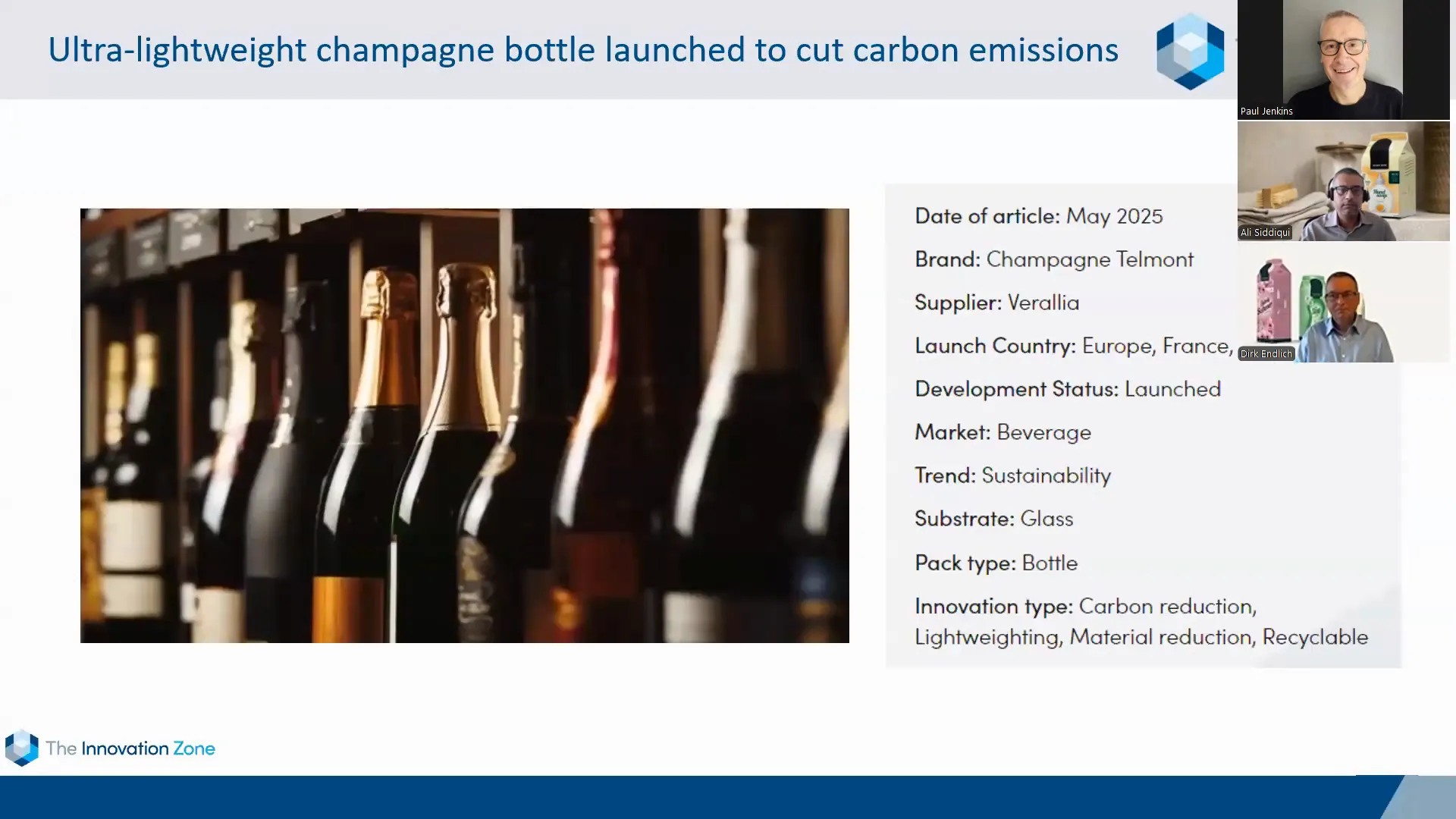
The webinar highlights a broad spectrum of packaging innovations targeting carbon reduction. For example, Champagne Telmont introduced the world’s first ultra-lightweight standard champagne bottle, reducing the bottle weight from 835 grams to 800 grams, cutting carbon emissions by 4% per bottle without compromising quality or pressure resistance. This innovation, debuting in the U.S. on Earth Day 2025, exemplifies lightweighting challenges in sectors where packaging weight is perceived as a quality indicator.
In the beauty sector, Abta Beauty and La Baratoire SVR launched recyclable airless bottles made from post-consumer recycled plastic designed to protect sensitive formulations while reducing CO2 emissions through in-house assembly. L’Oreal’s push for refillable packaging across its brand portfolio demonstrates a strategic approach to reduce packaging intensity and material impact by replacing traditional packaging with lower-footprint alternatives.

Pet care also sees innovation with Nestlé Purina Petcare’s recyclable canisters made entirely from mechanically recycled PET, expected to eliminate over 500 metric tons of virgin plastic annually, and reduce CO2 emissions by 694 metric tons.
2. Elopak’s Fiber-Based DPAC Cartons: A Game-Changer in Home and Personal Care Packaging
Dirk Endlich and Ali Siddiqui introduce Elopak’s DPAC cartons, emphasizing their low plastic content and high renewable fiber content. For instance, a one-liter DPAC carton contains only 8.9 grams of plastic—mostly in the lining, spout, and closure—compared to 70 grams in a typical HDPE bottle and 45 grams in a PET bottle. This represents an 80-90% reduction in plastic use.

Additionally, the square footprint of DPAC cartons enhances palletization and logistics efficiency, allowing more than twice the volume per truckload compared to HDPE bottles, and outperforming plastic pouches. This combination of reduced plastic and optimized logistics leads to a significantly lower carbon footprint.
Independent life cycle assessment by Anthesis revealed that DPAC cartons have a 78% lower carbon footprint than polypropylene bottles and 36% lower than plastic monolayer pouches, positioning DPAC cartons as a superior sustainable packaging solution.

3. Market Adoption and Consumer Acceptance
Though fiber-based cartons are less common in home and personal care categories, they have gained strong traction in Scandinavian markets, with brands offering a broad size range from 500 ml to 2 liters. Notable adopters include Unilever’s Persil and Comfort brands in the UK, and Ferrimax in Spain, demonstrating expanding acceptance and market availability.

Consumer studies indicate familiarity with carton packaging from milk and juice categories, with positive acceptance for personal care products. This opens opportunities for brands to differentiate their products and meet sustainability goals simultaneously.
4. Recyclability and Regulatory Trends
Elopak cartons are designed to be recyclable, with collection infrastructure already established in many regions. In the UK, 69% of local authorities collect cartons via household recycling, with another 25% offering bring banks. Upcoming legislation (Simpler Recycling) mandates carton collection by 2026, promising near-universal recycling access.
Recycling processes separate fiber from plastic and aluminum layers, repurposing fibers in new paper products and plastics and aluminum into new materials, achieving almost 100% recycling rates in countries like Germany.
5. Cost and Logistics Benefits of Carton Packaging
Cartons are delivered flat to production facilities, allowing roughly 20,000 units per pallet compared to 800 plastic bottles, drastically reducing transportation volume and costs. Post-filling, cartons also offer 50% more product volume per transport pallet than plastic bottles, lowering outbound logistics expenses.
Considering total cost of ownership (TCO), carton packaging often provides a financial advantage over plastic alternatives when factoring in logistics, recycling, and sustainability benefits.
6. Future Developments: Paper Closures and Enhanced Barriers
Elopak is actively developing paper-based closures for both food and personal care cartons to further reduce plastic use and carbon emissions. While only 5% of current SKUs require aluminum barriers, improvements in polyethylene barriers are expected to eliminate the need for aluminum in most cases without compromising shelf life.
7. Addressing Accessibility and Co-Packing
Accessibility is a recognized challenge in packaging design. Elopak tests closures extensively to ensure ease of use across age groups, including seniors and children. Isolated incidents of difficult openings are addressed individually.
For startups and small brands, Elopak offers co-packing solutions through qualified partners in Europe, enabling access to sustainable carton packaging without large-scale investment in filling equipment.
Frequently Asked Questions (FAQs)
- What are the key themes of the video?
The video explores carbon reduction innovations in packaging, focusing on lightweighting, plastic reduction, fiber-based cartons, recyclability, and market adoption across sectors. - What new information does this video provide compared to existing content?
It provides concrete data on carbon footprint reductions from DPAC cartons, real-world examples of adoption, and insights into the logistics and recyclability infrastructure supporting sustainable packaging. - What makes this video unique?
The integration of technical, consumer, and regulatory perspectives with detailed case studies across diverse industries offers a comprehensive and practical view of sustainable packaging innovation. - How can viewers apply the information shared?
Brands can evaluate the benefits of switching to fiber-based cartons or other innovations, understand cost and logistics implications, and prepare for evolving recycling regulations.
Summary and Final Thoughts
This comprehensive overview of carbon reduction packaging innovations underscores the importance of multi-sector collaboration and innovation to meet environmental challenges. From Champagne Telmont’s lightweight bottle to Elopak’s revolutionary DPAC cartons, the packaging industry is evolving rapidly towards more sustainable, recyclable, and lower-carbon solutions.
The main message is clear: sustainable packaging is not just a trend but a necessity, and fiber-based cartons represent a powerful tool for brands to significantly reduce their environmental impact while maintaining product quality and consumer appeal.
This video is essential viewing for packaging professionals, sustainability managers, brand owners, and anyone interested in the future of eco-friendly packaging solutions.
Key Figures and Resources
| Figure/Link | Description |
|---|---|
| Champagne Telmont Bottle | Ultra-lightweight champagne bottle reducing weight by 35g, cutting carbon emissions by 4% per bottle. (Timestamp: 03:02) |
| Elopak DPAC Carton Plastic Content | One-liter DPAC carton contains 8.9g plastic vs 70g in HDPE bottles, enabling 80-90% plastic reduction. (Timestamp: 21:04) |
| Carbon Footprint Comparison | DPAC cartons have 78% lower carbon footprint than polypropylene bottles and 36% lower than plastic pouches. (Timestamp: 26:08) |
| ThePackHub YouTube Channel | Official channel hosting the webinar and other packaging innovation content. |
| Dirk Endlich LinkedIn | Connect with Elopak’s VP for insights and queries about fiber-based packaging. |
Ready to dive deeper into carbon reduction packaging innovations? Watch the full video here: Carbon Reduction Packaging Innovations. Don’t forget to share your thoughts in the comments below and subscribe to our blog for more in-depth analyses like this!
This article was created from the video Carbon reduction packaging innovations with the help of AI.
Die Bedeutung des Verpackungsdesigns
Verpackungsdesign ist mehr als nur eine bunte Hülle für Produkte. Es beeinflusst, wie Verbraucher Produkte wahrnehmen und letztlich kaufen. Ein ansprechendes Design kann den Unterschied machen, ob ein Produkt im Regal auffällt oder nicht.
Uwe Melichar, ein erfahrener Verpackungsdesigner, hebt hervor, dass er beim Einkaufen oft einen anderen Blick auf Verpackungen hat. Er achtet darauf, ob Produkte überverpackt sind und ob deren Design ansprechend und nachhaltig aussieht. Diese Aspekte sind entscheidend, um im überfüllten Markt hervorzustechen.
Ästhetik vs. Funktionalität
Eine häufige Debatte im Verpackungsdesign ist die zwischen Ästhetik und Funktionalität. Oftmals wird angenommen, dass diese beiden Aspekte im Widerspruch zueinander stehen. Melichar argumentiert jedoch, dass sie Hand in Hand gehen sollten.
Ein Beispiel für funktionales Design ist der klassische Eierkarton, der nicht nur ästhetisch ansprechend ist, sondern auch die Eier schützt. Innovative Materialien, wie Formfaser, bieten sowohl Schutz als auch ein ansprechendes Design. Die Herausforderung besteht darin, das richtige Gleichgewicht zu finden, damit die Verpackung sowohl schön als auch funktional ist.
Nachhaltigkeit im Verpackungsdesign
Ein zentrales Thema, das Melichar anspricht, ist die Nachhaltigkeit. Verbraucher sind zunehmend besorgt über die Auswirkungen von Verpackungen auf die Umwelt. Daher ist es wichtig, dass Verpackungsdesigner Lösungen entwickeln, die sowohl ästhetisch als auch umweltfreundlich sind.
Melichar betont, dass viele Verbraucher nicht in der Lage sind, die Nachhaltigkeit einer Verpackung auf den ersten Blick zu erkennen. Daher ist es für Designer wichtig, Transparenz zu schaffen und die Verbraucher über die Nachhaltigkeit der verwendeten Materialien zu informieren.
Globale Perspektiven im Verpackungsdesign
Die Verpackungsindustrie ist global, und Melichar hat die Möglichkeit, mit internationalen Kunden und Märkten zu arbeiten. Unterschiede in den Kaufgewohnheiten und den Erwartungen an Verpackungen können erheblich variieren. In einigen Märkten, wie Indonesien, werden Produkte oft in kleineren Einheiten verkauft, was zu einem Anstieg von Verpackungsmüll führt.
Um diesen Herausforderungen zu begegnen, hat Melichar an der Entwicklung von wiederverwendbaren Containersystemen gearbeitet, die eine nachhaltige Lösung für den Verpackungsmüll darstellen.
Die Rolle des Designers
Als Designer sieht Melichar seine Rolle nicht nur in der Gestaltung von Verpackungen, sondern auch in der Moderation zwischen verschiedenen Interessen. Er arbeitet eng mit Marketingteams, Logistikern und Recyclingunternehmen zusammen, um sicherzustellen, dass die Verpackung den Anforderungen aller Stakeholder gerecht wird.
Ein wichtiger Aspekt ist die Kommunikation. Verpackungen müssen klare Informationen über den Inhalt und die Entsorgung enthalten, um den Verbrauchern zu helfen, die Verpackung korrekt zu entsorgen.
Innovationen in der Verpackungsindustrie
Die Verpackungsindustrie entwickelt sich ständig weiter, und neue Materialien und Technologien eröffnen spannende Möglichkeiten. Melichar spricht über alternative Verpackungsmaterialien, die aus landwirtschaftlichen Nebenprodukten hergestellt werden, wie z.B. Verpackungen aus Myzel oder Algen.
Diese innovativen Materialien bieten nicht nur eine nachhaltige Alternative, sondern auch das Potenzial, die Umweltbelastung durch herkömmliche Verpackungen zu reduzieren.
Die Zukunft des Verpackungsdesigns
Die Zukunft des Verpackungsdesigns wird von einer zunehmenden Nachfrage nach nachhaltigen Lösungen geprägt sein. Melichar sieht großes Potenzial in der Entwicklung von Verpackungen, die sich nach Gebrauch vollständig auflösen oder recyceln lassen.
Die Herausforderung besteht darin, sicherzustellen, dass diese neuen Materialien auch die erforderlichen Schutzfunktionen bieten und gleichzeitig das gewünschte ästhetische Erscheinungsbild bewahren.
Der Einfluss von Künstlicher Intelligenz
Ein weiteres spannendes Thema, das im Gespräch angesprochen wurde, ist der Einfluss von Künstlicher Intelligenz (KI) auf das Verpackungsdesign. Melichar sieht KI als Werkzeug, das Designer unterstützen kann, indem es hilft, Trends zu identifizieren und innovative Lösungen zu entwickeln.
Die Nutzung von KI in der Verpackungsentwicklung kann den Prozess effizienter gestalten und es Designern ermöglichen, sich auf kreative Aspekte zu konzentrieren.
Zusammenfassung
In der Verpackungsindustrie ist das Design von entscheidender Bedeutung, um sowohl ästhetische als auch funktionale Anforderungen zu erfüllen. Die Balance zwischen Ästhetik, Funktionalität und Nachhaltigkeit ist eine Herausforderung, der sich Designer wie Uwe Melichar täglich stellen.
Die Zukunft des Verpackungsdesigns wird von Innovationen und einem verstärkten Fokus auf Nachhaltigkeit geprägt sein. Durch die Integration neuer Materialien und Technologien sowie den Einsatz von Künstlicher Intelligenz wird die Branche weiterhin neue Wege finden, um den sich ändernden Bedürfnissen der Verbraucher gerecht zu werden.